
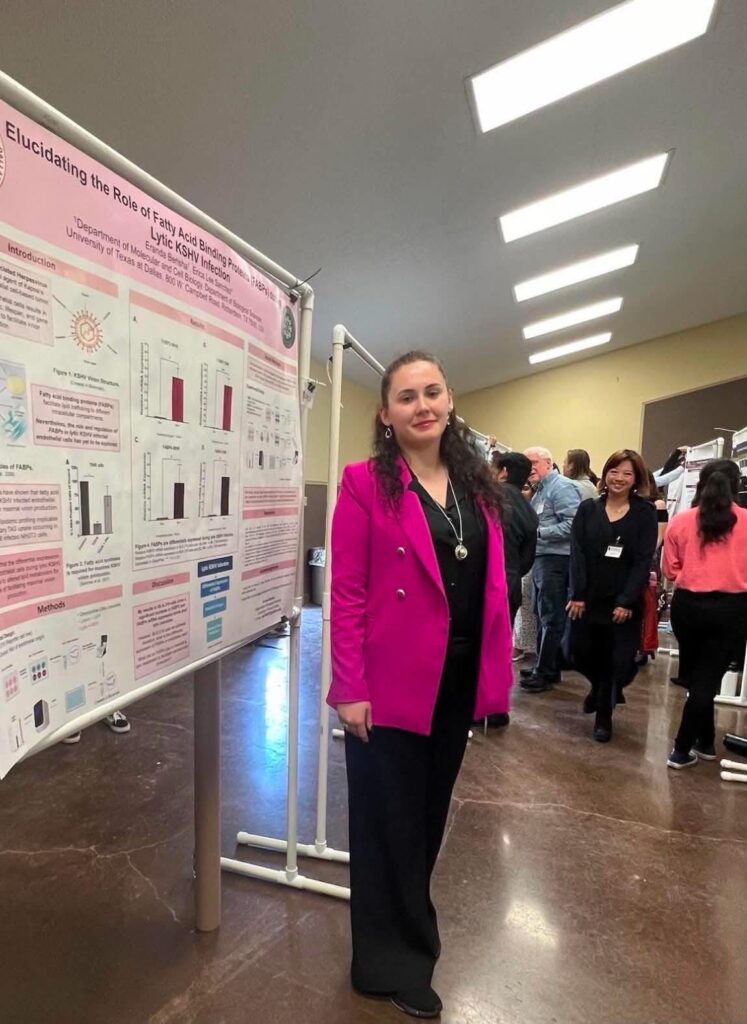
A young Albanian scientist in the United States is gaining attention for a promising breakthrough in cancer research after four years of intensive scientific work.
Eranda Berisha is preparing to present her doctoral dissertation in Genetic Engineering and Cellular Technology Science at University of Texas at Dallas, where her research has focused on understanding how certain cancer-related viruses develop and spread.
Her study examines KSHV, the virus associated with Kaposi’s Sarcoma, a rare form of cancer. During the research, Berisha identified a protein known as FABP4 as a key factor in helping the virus reproduce and promote the development of cancer cells.
The findings explain how the virus manipulates fats inside human cells in order to survive and multiply — a discovery that researchers believe could help open new possibilities for future anti-cancer treatments.
The project has received support from several internationally recognized institutions, including Chan Zuckerberg Initiative, Cold Spring Harbor Laboratory, Massachusetts Institute of Technology, Stanford University, and Imperial College London.
Her scientific paper has also been published on BioRxiv, a major platform used by researchers worldwide to share new scientific findings before formal peer review.








That’s a great point about balancing risk & reward! Seeing platforms like LuckyStarz embrace local payment options (GCash, PayMaya) is smart. Check out luckystarz download for a streamlined experience – quick registration is a plus! 👍