
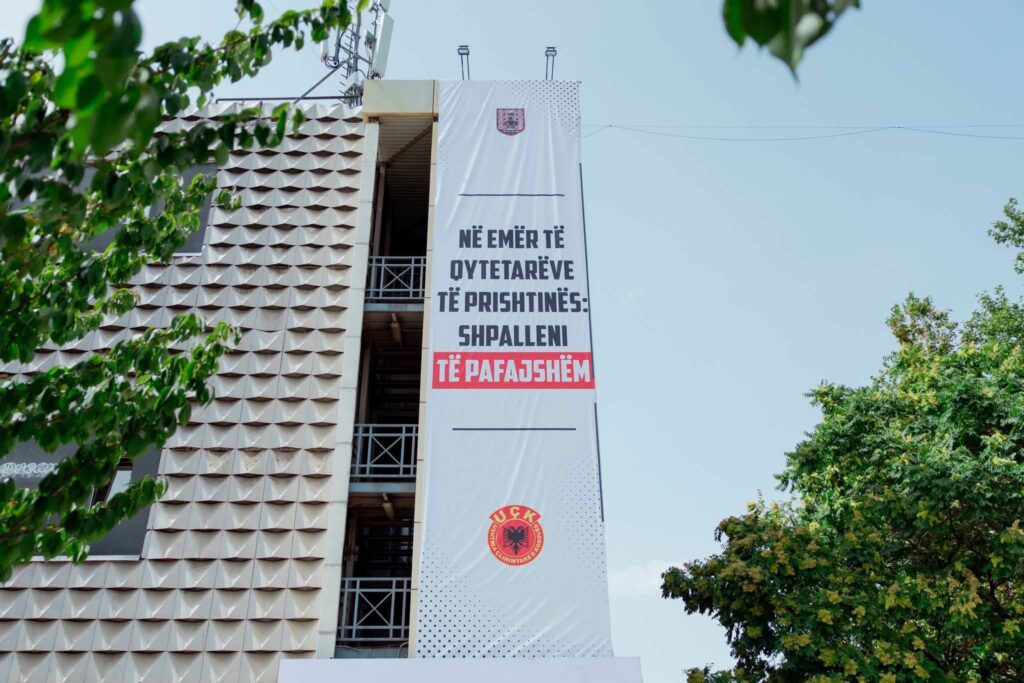
A large banner calling for the acquittal of Hashim Thaçi, Kadri Veseli, Jakup Krasniqi and Rexhep Selimi has appeared in central Prishtina, days before supporters are expected to gather in the capital ahead of the long-awaited verdict in their Hague trial.
The banner reads “In the name of the citizens of Prishtina: DECLARE THEM INNOCENT” and calls for the four former Kosovo Liberation Army leaders to be found not guilty and returned to Kosova.
The message comes as the case approaches its decisive moment.
The Kosovo Specialist Chambers have scheduled the judgment for September 16, 2026, at 10am, when the judges will announce their decision in the case.
Before that, a major protest has been announced in Prishtina for September 12, four days before the verdict. The event is expected to bring supporters of the four former KLA leaders together in the capital.
Thaçi, Veseli, Krasniqi and Selimi are among the most prominent political and military figures associated with the KLA during the 1998–99 war.
They were arrested and transferred to the Specialist Chambers’ detention facilities in The Hague in November 2020. Krasniqi was arrested on November 4, while Thaçi, Veseli and Selimi were arrested on November 5.
They have therefore spent nearly six years in detention while the case has made its way through the Hague court.
The trial began on April 3, 2023, following more than two years of pre-trial proceedings. The prosecution presented its case before the defence presented its evidence, and closing statements were heard in February 2026.
All four have pleaded not guilty.
The indictment accuses them of individual criminal responsibility for alleged crimes committed between March 1998 and September 1999 in several locations in Kosova, as well as Kukës and Cahan in northern Albania.
The charges include persecution, imprisonment, other inhumane acts, torture, murder and enforced disappearance as crimes against humanity, as well as illegal or arbitrary arrest and detention, cruel treatment, torture and murder as war crimes.
Prosecutors allege that the crimes were committed against hundreds of civilians and others who were not taking part in hostilities as part of a widespread and systematic attack against people suspected of opposing the KLA.
The defence has rejected the allegations and argued that the prosecution has failed to establish the criminal responsibility of the four accused.
A central issue in the defence case has been the structure of the KLA and, in particular, whether Thaçi had effective command and control over its military structures.
Among the most prominent defence witnesses was James Rubin, the former US Assistant Secretary of State and State Department spokesman during the Kosovo War.
Rubin testified about his dealings with Thaçi during the Rambouillet negotiations and the subsequent process surrounding the KLA’s demilitarisation. He described Thaçi primarily as a political figure and testified that he did not view him as the military commander of the KLA.
Other prominent international figures also appeared as defence witnesses.
Paul Williams, a US lawyer who worked with Kosovo’s delegation during the Rambouillet negotiations, testified about the organisation and structure of the KLA.
John Duncan, a former British diplomat and adviser to NATO’s commander in Europe, gave evidence concerning the KLA’s command structure during the war.
James “Jock” Covey, a senior US diplomat who served with UNMIK, also testified about the KLA and Thaçi’s role.
Christopher Hill, the veteran US diplomat and former American envoy during the Kosovo negotiations, appeared as a defence witness in November 2025.
One of the most high-profile witnesses was General Wesley Clark, NATO’s Supreme Allied Commander Europe during the Kosovo War. Clark testified about the KLA’s military structure and Thaçi’s role during the conflict.
The defence has argued that there is insufficient evidence to establish that Thaçi personally committed the alleged crimes or exercised the level of command authority necessary to hold him criminally responsible for crimes committed by others.
The judges have yet to announce their decision.
That moment will come on September 16 in The Hague.




The login is secure and the page loads fast on my mobile. I prefer using this over others because it just works every time without crashing. 76xbetlogin
the examples helped a lot, especially the second one