
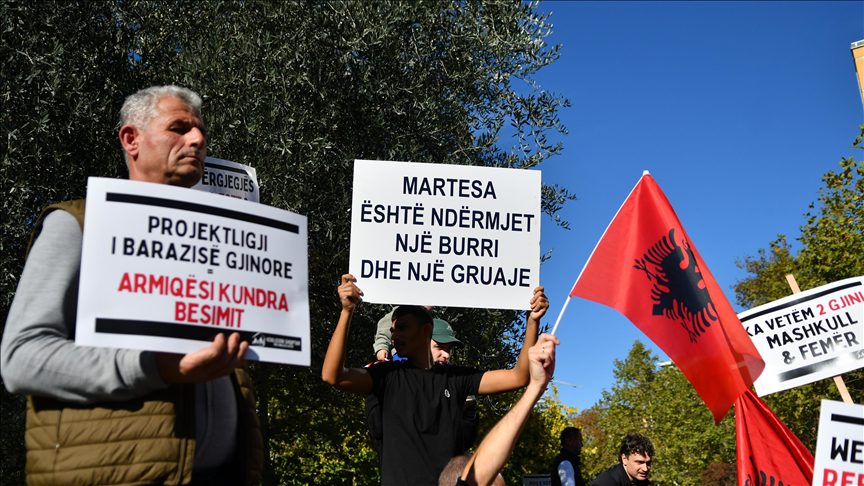
Albania’s Parliament has passed a new Gender Equality Law, rewriting how the term “gender” is defined in national legislation and setting off one of the country’s most divisive public debates in recent years. The law was approved on November 6, 2025, with 77 votes in favour, 36 against and 4 abstentions, following weeks of protests in the capital and across the country.
The reform was introduced by the Ministry of Health and Social Welfare with the stated aim of aligning Albania’s legislation with European Union standards on equality and non-discrimination. The original draft defined gender as “inclusive,” allowing citizens to self-declare their gender identity — a move that supporters hailed as progressive and consistent with international human-rights frameworks.
But the proposal quickly provoked a fierce backlash from religious institutions, conservative groups and opposition parties, who warned it threatened Albania’s traditional family structure and cultural identity. Protesters accused the government of promoting “gender ideology” and demanded the bill be withdrawn entirely.
Under mounting pressure, the ruling Socialist Party introduced 22 amendments ahead of the vote, removing the phrases “inclusive gender,” “gender identity” and “gender expression.” The final version of the law limits its scope to equality between men and women in areas such as employment, education, political participation and decision-making.
Despite the changes, thousands of citizens returned to the streets on the day of the vote, arguing that the very act of altering the legal definition of gender marked a dangerous precedent. Demonstrators outside Parliament carried banners reading “Protect the Family” and “No to Gender Agenda,” accusing lawmakers of eroding social norms.
Inside the chamber, Socialist MPs defended the legislation as a necessary modernization and insisted it “does not change biological reality” but simply guarantees equal treatment under the law. Opposition members, however, called it a “Trojan horse” that could later be used to reintroduce the inclusive definitions through administrative regulation.
The Interreligious Council of Albania released a statement saying the law “still lacks guarantees to preserve the traditional family,” while rights organizations lamented that the amendments had stripped away protections for LGBTQ+ citizens, calling it “a lost opportunity for Albania to meet EU equality standards.”
The European Commission welcomed the outcome, describing the reform as “a key step toward alignment with European human-rights principles.” Yet for many Albanians, the vote symbolized something larger — a clash between the country’s aspiration to integrate with Europe and its deep-rooted attachment to conservative social values.
The Gender Equality Law will enter into force once published in the Official Gazette, but the debate it has unleashed over gender, culture and identity is likely to continue long after the ink dries.






79xapp, huh? Downloaded it last week. Honestly, not bad! Runs smooth, and the interface is clean. Give it a spin, 79xapp, see what you think.
JLbetPH is cool, it feels more tailored for us Filipinos. Has lots of what we are looking for. Give jlbetph a go, you might like it!
Hey there! Gave win99club a try the other day. Pretty decent selection of games, and the signup process was a breeze. If you’re looking for a new spot to hang out online, give it a shot!
Hey guys, been trying out demopgslot and it’s super useful for practicing before playing for real. It lets you get a feel for the games without risking any dough. Check it out at demopgslot.
Yo 188betlinkvao, are you the shortcut I’ve been searching for? Tired of hunting down working links. Hope your site is smooth and reliable, ya know? One click and I’m in! Find it at: 188betlinkvao
Yo, checked out Megaacevn and gotta say, the site’s pretty smooth. Loads fast, games are decent. Definitely worth a look if you’re hunting for something new. Check it out here: megaacevn