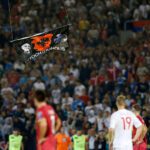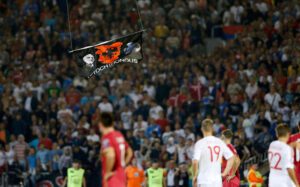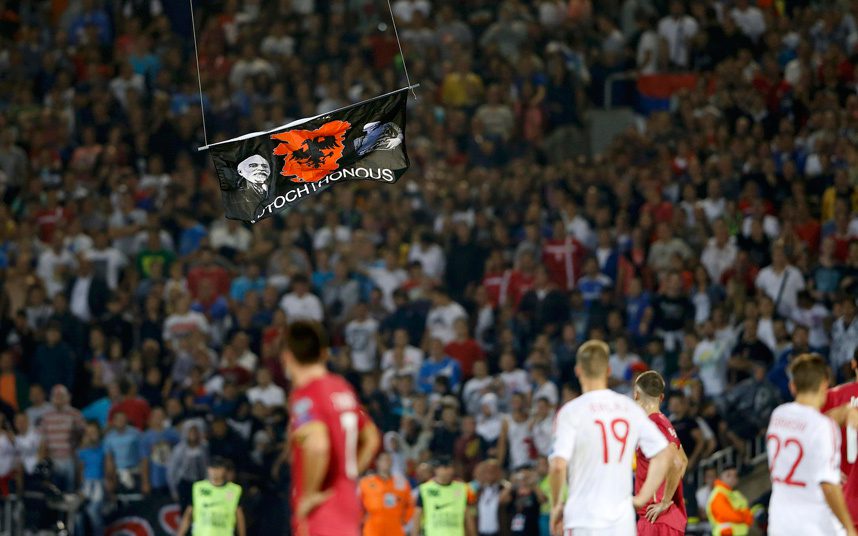
Twelve years ago tonight, Serbian hooligans at Partizan Stadium in Belgrade spent the first half chanting “Kill the Albanians.” Then a small drone rose over the stands carrying a red-and-black banner, and the night ended with Albania’s players fighting off attackers on the pitch.
Albanian fans had been banned from the Euro 2016 qualifier on Oct. 14, 2014, and every Albanian symbol was forbidden. The hostility began before kickoff. The Albanian Football Association said its team bus was stoned and a chunk of concrete was thrown at its delegation. Players leaving the warm-up were showered with coins and lighters.
The Albanian anthem was drowned out by whistles. Serbian fans burned a NATO flag and threw flares at Ansi Agolli as he lined up a corner. A bottle was hurled at Bekim Balaj, and substitutes warming up on the sideline were hit by hard objects. Through all of it, Albania held Serbia at 0-0.
In the 42nd minute, English referee Martin Atkinson stopped play because of yet more flares. That is when the drone appeared.
Beneath it hung a banner with Ismail Qemali and Isa Boletini, the date 28 November 1912, a map of Albanian lands across the Balkans and a single word in English: “Autochthonous.”
Serbian defender Stefan Mitrović jumped and tore it down. Andi Lila and Taulant Xhaka rushed to defend the flag. Bekim Balaj took it back — and a Serbian fan ran onto the pitch and hit him over the head with a plastic stool. Captain Lorik Cana took the attacker to the ground. Within seconds, Serbian hooligans were pouring onto the field and attacking Albanian players with chairs and whatever they could throw.
The Albanians ran for the tunnel under a hail of objects, while the Serbian players walked off to a standing ovation. The Albanian federation said its players were attacked by stewards and police on the way to the dressing room. Cana said his players were hit “even inside the tunnel, and even by the stewards.”
Then, on orders from Belgrade’s chief prosecutor, police searched every Albanian player and every bag for the drone’s remote control. They found nothing. Four Albanian players were injured. After a 30-minute delay, the match was abandoned.
Serbian officials accused Olsi Rama, the brother of Albania’s prime minister, of flying the drone from the VIP box, and police searched him too. The accusation was never proven. The real pilot was already driving south toward Kosova.
His name was Ismail Morina, known as Ballist — a crane operator and father of two from Shikaj, a village near Kukës, who had lived in Italy since 2004. He told Digitalb in 2015 that the idea was born in 2010, when a Serbian hooligan burned an Albanian flag at a match in Genoa. When the 2014 draw put Serbia and Albania in the same group, an Italian friend joked that the Albanians should answer with a small helicopter carrying a message.
Morina spent months preparing. He practiced flying for more than a month on a friend’s land in Italy. A huge banner lifted by two drones failed, so he settled on a 1.2-by-1.7-meter flag and a single drone. Friends from the fan group Tifozat Kuq e Zi helped cover the 5,000 to 7,000 euros it cost.
On Oct. 10, he kissed his sleeping children goodbye and drove about 12 hours from Milan. At the Croatian-Serbian border, officers wanted to know why a man in a modest car was carrying three drones worth 3,000 euros. Gifts for his nephews, he told them.
For three nights he scouted the streets around the stadium. He picked a church about 50 to 70 meters away, betting that a place of worship would draw less police attention. A friend from Skopje, whom he knew only online, joined him the night before the match.
On match day, he slipped in before the police cordon went up and lay hidden between pine trees and the church fence for 17 hours. He had planned to launch during the anthems, but a drunk man lingering nearby cost him half an hour. With the first half nearly over, he climbed a drainpipe to the church arches, the remote clenched in his teeth.
He flew a loop over the neighborhood, brought the drone in from the far side and steered it four times toward the VIP stand, where he knew senior Serbian officials were sitting. Then, thinking the players in red were Albania’s, he lowered the flag toward them. They were Serbia. “The colors of my heart betrayed me,” he said.
He left the remote on the church, slid down the pipe and slipped past two police patrols on his way back to the car. He and his friend drove straight for the border. On the Kosova side, he asked the police how the match had gone. “Brother, all hell broke loose. Isa Boletini and Ismail Qemali have landed in Belgrade,” they told him. By 5 a.m., he was in Prishtina.
That night, thousands of fans welcomed the national team at Tirana’s airport, and around 15,000 people celebrated in Mother Teresa Square. In Serbia, at least a dozen Albanian-owned bakeries and shops in Vojvodina were set on fire after the match, one of them with a bomb.
UEFA’s first ruling handed Serbia a 3-0 win, blaming Albania for refusing to return to the pitch, though it docked Serbia three points and fined both federations 100,000 euros. Cana said the referee never ordered his team back out, only asked whether the players were fit to continue.
The Court of Arbitration for Sport overturned it. On July 10, 2015, it threw out Serbia’s appeal entirely and ruled that the abandonment was caused by the organizers’ security failures and by violence against Albanian players from Serbian fans and at least one steward. Albania was awarded a 3-0 win. Serbia kept its point deduction and its fine, and still had to play two home games behind closed doors.
Those three points sent Albania to its first major tournament. After a 3-0 win in Armenia on Oct. 11, 2015, Albania finished second in the group with 14 points, two ahead of Denmark, and qualified for Euro 2016 in France. Serbia finished fourth with four points. Eleven years after Belgrade, on Oct. 11, 2025, Albania returned to Serbia and won 1-0 in Leskovac.
Serbia kept hunting Morina. In June 2017, Croatian police detained him in Dubrovnik on a Serbian warrant for inciting hatred. Croatian courts approved his extradition, but Albania’s government, president and football federation fought it for months. In the end, Croatia’s justice minister refused to hand him to Serbia and sent him to Italy, where he was freed in July 2018.
Morina says he was never afraid and regrets nothing. On the 10th anniversary, he credited the players who protected the flag that night, writing that without them, none of it would have meant anything.