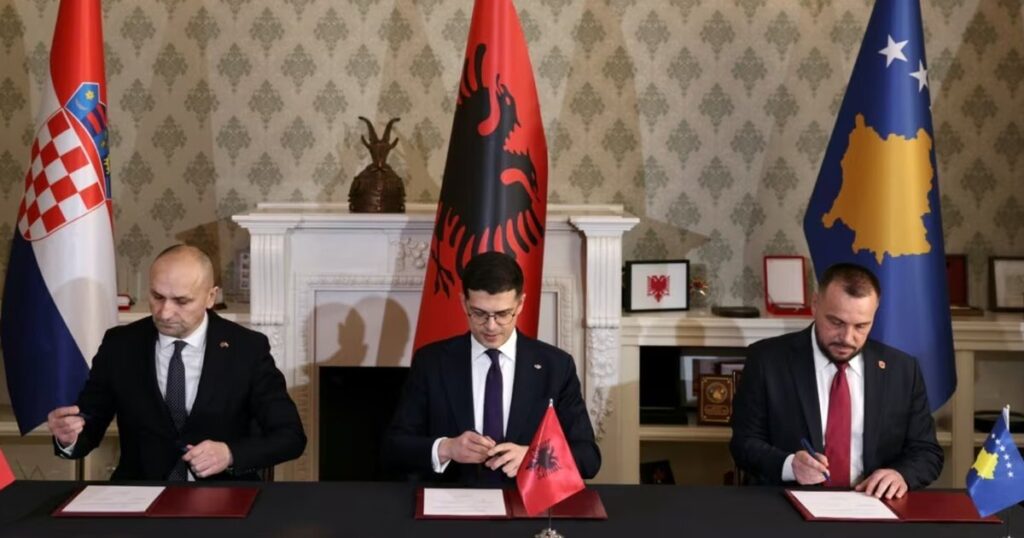
Kosovo, Albania and Croatia are working to put into practice the cooperation in the field of defense that was agreed on paper about five months ago, when the Defense Ministers signed a joint declaration on March 18 in Tirana.
The Defense Ministries of Kosovo and Albania confirmed to Radio Free Europe that expert groups are working on a plan to implement the declaration.
Kosovo’s acting Minister of Defense, Ejup Maqedonci, says that on July 18, an implementation group meeting was held in Tirana “to break down the plan at an operational level.”
The Albanian Ministry of Defense, which hosted the agreement signing ceremony, said that in September of this year, the guide, which is nearing finalization, will be presented for approval to the ministries of Albania, Kosovo, and Croatia.
In the declaration signed by the acting Minister of Defense of Kosovo, Ejup Maqedonci, that of Albania, Pirro Vengu, and that of Croatia, Ivan Anušić, four points of cooperation were established: Promoting defense capacities and cooperation for the relevant industry; Increasing interoperability through education, training and exercises; Countering hybrid threats and increasing resilience; Providing full support for Euro-Atlantic integration.
The text of the declaration stated that this cooperation is to ensure good positioning to confront threats and achieve defense and security objectives.
Joint arms purchases
The acquisition of defense capabilities is the first commitment in the declaration to which the Defense Ministers pledged.
In this regard, according to Makedonci, the aim is to place one purchase order, instead of three separate orders from each country.
“For example, a [weapons] system that all three countries are interested in purchasing from the US, we can place the order as a single purchase, using the legislation of each country, but the quantity and delivery time should be determined jointly, because when you buy more from the US, they cost less and arrive faster,” the Macedonian tells Radio Free Europe.
These purchases are expected to be made with national funds of each country.
The Macedonian expects that the partner states in this agreement will help Kosovo towards Euro-Atlantic integration, as they say they pledge in the declaration, specifically regarding Kosovo’s membership in NATO’s Partnership for Peace.
Months ago, the Croatian government told Radio Free Europe that this initiative could be joined by all countries that also want to offer support to Kosovo and Albania on their European and Euro-Atlantic path.
So far, it has not been officially announced whether any other country will join this cooperation.
The purpose of the cooperation, according to the Croatian Government, “is not the creation of any military alliance.”
“Such an alliance – apart from NATO membership – is not even necessary,” the Croatian government said in March of this year.
The declaration on cooperation in the field of defense and security between Albania, Croatia and Kosovo has four points, one of which refers to the promotion of cooperation in the defense industry.
Acting Minister of Defense, Ejup Maqedonci, says they will use the next US-Adriatic Charter [A5] meeting, expected to be held in October of this year, to urge regional partners to join.
Members of the Adriatic Charter are Albania, Croatia, Macedonia, Montenegro and Bosnia and Herzegovina, while Kosovo holds observer status.
Expectations from the agreement
In addition to cooperation in the arms industry, the countries are expected to conduct bilateral and trilateral military exercises as well as cooperate in personnel recruitment by increasing educational opportunities through military academies and colleges.
There is also expected to be a joint commitment to countering hybrid threats “including cyber threats, disinformation campaigns, as well as malign foreign influence that could compromise or affect national and regional security.”
It is envisaged that information and intelligence services will be exchanged between partner states in this agreement to prevent common challenges.
The Macedonian says that this agreement was welcomed at the Pentagon when he visited the US in June of this year.
“They saw it as a good opportunity for regional cooperation to address challenges,” he says, adding that they have also received support from many NATO countries, without specifying which countries are involved.
However, Serbia opposed this cooperation, whose president, Aleksandar Vučić, said that the 1996 subregional agreement was being violated.
This agreement, which concerns the permitted quotas in armaments, was signed at the time by the two entities of Bosnia and Herzegovina – the Federation of Bosnia and Herzegovina and Republika Srpska, as well as by Croatia and the Federal Republic of Yugoslavia, which consisted of Serbia and Montenegro.