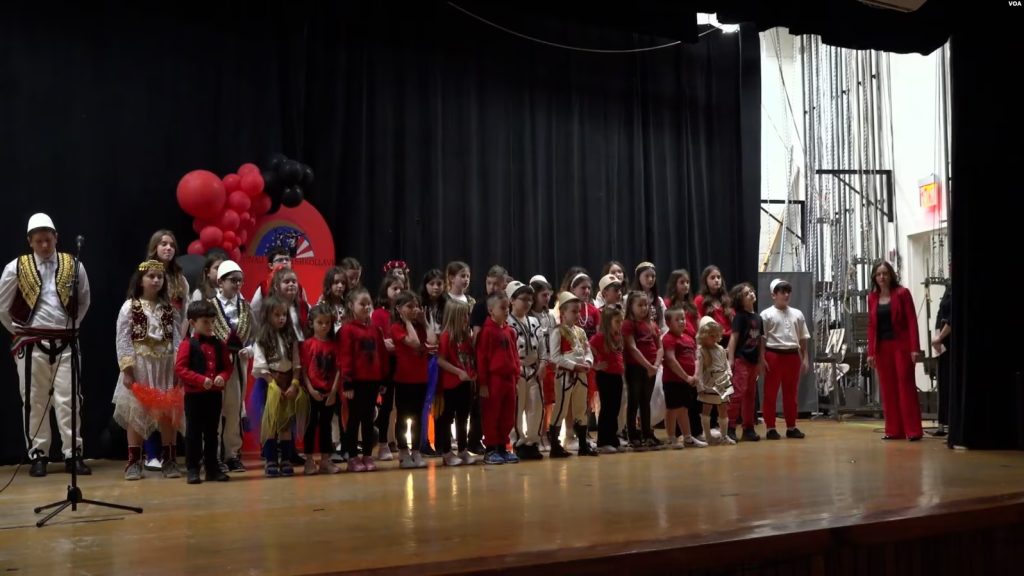
One day ago, the Sixth Albanian School Festival was held in the Bronx, New York, a cultural event that returned after a several-year hiatus. Students from several Albanian schools in New York, New Jersey, and Connecticut brought a rich cultural program.
“My name is Fatmir… My name is Nikoleta.”
Fatmir and Nikoleta Vuçinaj, siblings born in the United States, are students at the Albanian school “Children of the Eagle” in New York.
On Sunday, they took the stage at the Iliria Center in the Bronx, New York, where the sixth edition of the Albanian school festival was held.
The program also included students from the Struga Cultural Center School in New Jersey, the Hasan Prishtina Association School in Connecticut, and the “Learn Albanian” school in Staten Island, New York.
The students welcomed the decision to bring back the festival after a several-year interruption.
“We need to learn Albanian. I have many relatives who speak Albanian. And it’s good to know our history because then we know where we come from and who we are,” says student Luka Vuksanaj.
“Being in America, we live with different cultures. In order to learn about our own culture, we need such organizations. Through this organization, we can learn about our parents’ past,” says student Anida Osmanaj.
“It feels good because I can learn more about my culture and traditions. It’s very important because I learn about my ancestors’ past,” says student Skyler Vladi.
“I have my whole family there (in Ulcinj). But when we came here, we wanted to continue, so we don’t forget where we come from,” says Ani Dobroqi, Albanian-American from Ulcinj.
“Never forget where you come from. I told that to my friends. That’s all we need. Learn history as much as you can. I was born in the United States, but I visit my home country every summer,” says Eldin Zaga, an Albanian-American dancer.
Drita Gjongecaj, one of the festival’s organizers, says events like this make the future generations of Albanian-Americans serve as ambassadors of their countries of origin.
“They are the ones who will know how to defend the interests of the nation. They are the ones who, even today, as they learn more about history and become familiar with the language and create freedom in its use, need to be able to understand what is happening in our countries,” she says to Voice of America.
Parents say it is a special feeling to see their children in such an organization.
“The most important thing I always ask my daughter is ‘where are you from?’ And the first thing she says is that she is Albanian but was born here. The most important thing for me is culture. It doesn’t matter how many years you’ve been here or if you were born here,” says Besiana Stefa.
“Circumstances forced us to leave our country, but at least our children learn, they know where they come from, and I think that is very important,” says Demë Hsangjekaj.
“It is important that these traditions are passed on. We learn, and our children are very happy to be part of this program,” says Ferzileta Gjika.
The transmission of language and culture from one generation to another is possible, says activist Gonxhe Meta, who was once a student at the Albanian-American cultural center “Struga” in New Jersey, founded in 1978 and now directs it.
“I was born here and went to this school (Albanian-American Cultural Center Struga) when I was young. My children were also students at that school. I have the preservation of the Albanian language and traditions in my blood,” she says.
The success of children does not depend solely on their participation in Albanian language classes, say teachers and school administrators.
“It also depends on the parents because they need to work with the children themselves. In one hour, what can a teacher do? The family also needs to work a little with the language at home so that we can preserve it,” says Agim Ismaili from the organization “Hasan Prishtina.”
“I try every day to motivate Albanian parents to speak Albanian at home, but also to follow wherever there are schools or programs in the Albanian language, or dances, and everything else,” says teacher Life Buzhiqi.
The festival organizers say that the interest of Albanian-Americans in preserving their language and culture has always been significant. But now, with the increase in organizations and Albanian schools, more opportunities have been created, and the number of students is continuously increasing./VOA