
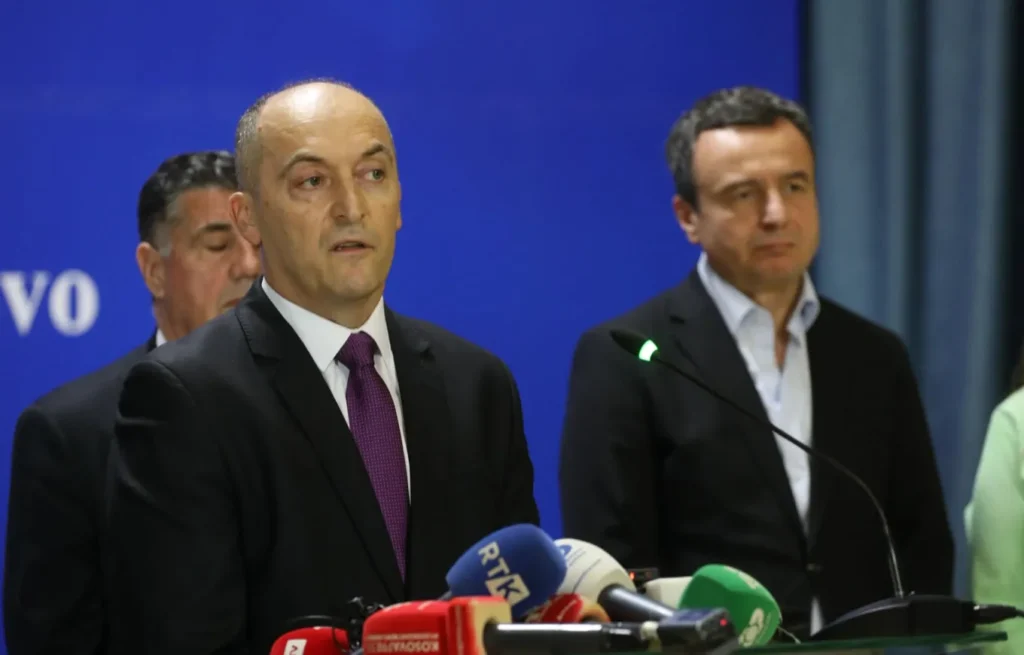
Bekim Sejdiu has been chosen as the joint presidential candidate of the Vetëvendosje Movement (VV) and the Democratic League of Kosova (LDK), after Albin Kurti and Lumir Abdixhiku reached an agreement aimed at ending the country’s political deadlock.
Abdixhiku confirmed the agreement on Monday following his meeting with Kurti, saying the two parties had been negotiating since July 9 in an effort to find a solution without new elections.
After considering several names, VV and LDK agreed on Sejdiu, a law professor, diplomat and former Constitutional Court judge.
“The talks were not easy, but they were exhaustive” Abdixhiku said.
Sejdiu accepted the nomination, describing it as a great honor and responsibility.
“It is a great trust, it is a great honor. I have accepted this proposal” Sejdiu said, a8dding that his goal is to serve the Republic of Kosova and its citizens.
Who is Bekim Sejdiu?
Born in 1974, Sejdiu has spent more than two decades working across academia, diplomacy, constitutional law and civil society.
He completed his law degree at the Faculty of Law of the University of Prishtina in 1999. He later completed a master’s degree in international relations at Bilkent University in Turkey in 2005, as well as postgraduate studies in democracy and human rights at the University of Sarajevo and the University of Bologna.
He earned his doctorate in international and diplomatic studies at the Faculty of Government and European Studies of Nova Univerza in Slovenia.
Since 2002, Sejdiu has been a professor at the Faculty of Law of the University of Prishtina, where he has worked in the field of international law.
His career in public service began before Kosova’s independence. From 2000 to 2002, he served as a program director at the Kosovo Foundation for Civil Society. He was also among the founding members of the Kosovo Institute for Policy Research and Development (KIPRED), serving as a member of its Council of Professional Researchers from 2002 to 2008.
Sejdiu later entered Kosova’s diplomatic service and became part of the country’s first generation of ambassadors.
From 2008 to 2012, he served as Kosova’s ambassador to Turkey. He then served as Kosova’s Consul General in New York from 2012 to 2014.
Before becoming ambassador, he worked as a political adviser in the cabinet of Kosova’s first Minister of Foreign Affairs.
In April 2015, Sejdiu was appointed a judge of the Constitutional Court of Kosova. He served on the Court until 2021, when he resigned.
During his public career, Sejdiu has received several distinctions, including a decoration from the New York State Assembly, the Key to the City of Worcester, Massachusetts, and a medal from Turkey’s Minister of Foreign Affairs.
He has also taken part in academic study visits to universities across Europe and the United States and has published academic work in international and domestic scientific journals.
Throughout his public and academic work, Sejdiu has focused on areas including the rule of law, human rights, social tolerance and gender equality.
The judge behind the Hoti government ruling
Sejdiu’s six years at the Constitutional Court placed him at the center of some of the most consequential constitutional cases in Kosova.
He served as reporting judge in several major cases, including the case concerning the election of Avdullah Hoti as prime minister in 2020.
Sejdiu was the reporting judge for the Constitutional Court’s judgment that found Hoti’s election unconstitutional because one of the votes supporting his election had been cast by a member of parliament with a final criminal conviction.
The judgment led to the dissolution of the Assembly and paved the way for new parliamentary elections in Kosova.
His judicial record also includes several cases in which he issued dissenting opinions, formally presenting a legal interpretation different from that of the Court’s majority.
In Case KO130/15, concerning the Association/Community of Serb-majority municipalities, Sejdiu issued a dissenting opinion addressing aspects of the Court’s constitutional reasoning concerning the Association.
He also issued dissenting opinions in KI135/14 and KI34/17, concerning constitutional and fundamental-rights questions.
During the COVID-19 pandemic, he dissented in KO61/20, a case concerning the decision to place Prizren under quarantine. While the majority found the decision unconstitutional, Sejdiu took a different legal position and emphasized the state’s responsibility to protect the right to life and public health.
These opinions are part of his broader judicial record and reflect his independent approach to constitutional questions during his time on the Court.






Really liking the variety of games here. Everything feels fresh and the customer support is top notch. Give rosohokilogin a try for sure.
Installation was a breeze and the game started right up. No complicated steps, just pure fun with pkx555gamedownload.
The app is super lightweight and doesn’t crash. Perfect for playing on the go during my commute. Download bdtk444app now.