
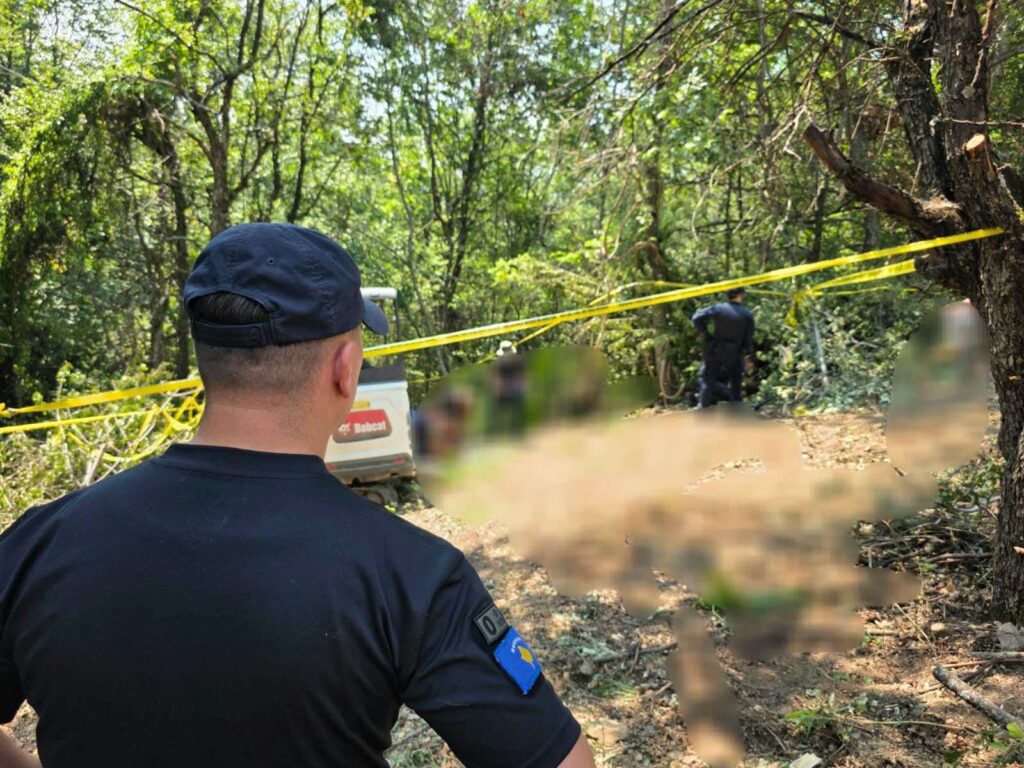
The remains of at least 23 people have been found at three locations in Zubin Potok during excavations into suspected mass graves linked to the 1998–1999 war, authorities said.
The remains were discovered in Kalludër and nearby Jabukë, where excavations have been underway since July 28 following a two-year investigation into suspected war crimes.
Bajram Limani of Kosova’s Government Commission on Missing Persons said 20 of the 23 bodies have so far been exhumed and transferred to the Institute of Forensic Medicine. The remaining three were expected to be recovered on Thursday.
“Remains of 23 people have been found, but not all have been exhumed and sent to the Institute of Forensic Medicine,” Limani said. “So far, 20 have been exhumed, the final three are being recovered today, and we hope this process will be completed today.”
According to Limani, 13 bodies were found at the first site in Kalludër, while four were recovered at a second site in Jabukë.
Six more bodies were found at a third location in Kalludër, around 300 to 400 metres from the first site. Three have already been exhumed, with the remaining three expected to be recovered and transferred to the Institute of Forensic Medicine.
Authorities have stressed that the remains have not yet been fully identified. Their identities will be determined through forensic examinations and other procedures.
The discovery could be connected to one of the most painful unresolved cases from the war.
Albin Kurti, Kosova’s acting prime minister, previously said the remains found in Kalludër e Vogël could belong to a group of 23 Albanians who disappeared in the area on 19 April 1999.
The group, known as the “Mitrovica Intellectuals”, included doctors, professors, lawyers and other professionals. They have remained missing for more than 27 years.
For the families, the excavations have brought hope as well as renewed pain.
Lutfije Ademi-Vokshi, whose brother Adem Ademi, a doctor, was among those who disappeared, told Radio Free Europe that she believes the remains could belong to the group.
She said that finally having a grave for her brother would allow the family to visit him, remember him and bring flowers on important occasions.
The excavations began after a two-year investigation into suspected war crimes. Kalludër e Vogël and Jabukë are around five kilometres apart.
The case has also led to three arrests. Kosova’s Special Prosecution Office is investigating J.R., M.J. and M.B. on suspicion of war crimes against civilians. All three are in detention. One of the suspects is believed by authorities to have been an active member of the Yugoslav Army during the war.
The latest findings come as 1,577 people remain missing from the 1998–1999 war, according to Kosova’s Government Commission on Missing Persons. The figure follows 11 identifications completed in March 2025.
The war left thousands of people dead and thousands missing. Senior political and military figures from Yugoslavia and Serbia were prosecuted by the International Criminal Tribunal for the former Yugoslavia over crimes committed during the conflict.
Slobodan Milosevic, the former president of Yugoslavia, was charged with war crimes and crimes against humanity committed in Kosova, as well as in Bosnia and Herzegovina and Croatia. He died in detention in 2006 before a verdict could be reached.
Dragoljub Ojdanic, the former chief of staff of the Yugoslav Army, was sentenced to 15 years in prison for crimes against humanity. Nebojsa Pavkovic, former commander of the Yugoslav Army’s Third Army, was sentenced to 22 years for crimes against humanity and violations of the laws or customs of war.
Milan Milutinovic, the former president of Serbia, was acquitted of charges related to crimes committed during the Kosova conflict.
Despite those international prosecutions, the fate of thousands of people who disappeared during the war remains unknown.
Kosova has repeatedly called on Serbia to cooperate in locating missing persons and to open military archives that could help identify suspected burial sites.
The remains found in Zubin Potok will now undergo forensic examinations and DNA analysis. Only after that process will authorities be able to determine who the victims were and whether the remains belong to the 23 Albanians who disappeared in April 1999.




The graphics are top notch and the gameplay is very immersive. It is definitely one of the top choices for gaming in the region. See phjili90
Super easy registration process and the site loads quickly on my phone. It is just a straightforward and reliable place to play. Glad I found idmpobos
Just signed up for betbhaired9 and I’m liking what I see so far. A good range of options and the site is easy to use. Fingers crossed for some wins! Check it out if you’re feeling lucky. betbhaired9
The registration process was a breeze and I started playing in under two minutes. Great service from balislotlogin
I’ve tried a few sites recently, but the interface here is just smoother. Really liking the game variety on phokebet6, definitely worth a try for anyone looking for a little excitement.